KTC H32S17F Analysis: 240Hz at a Real Cost
My Honest Verdict
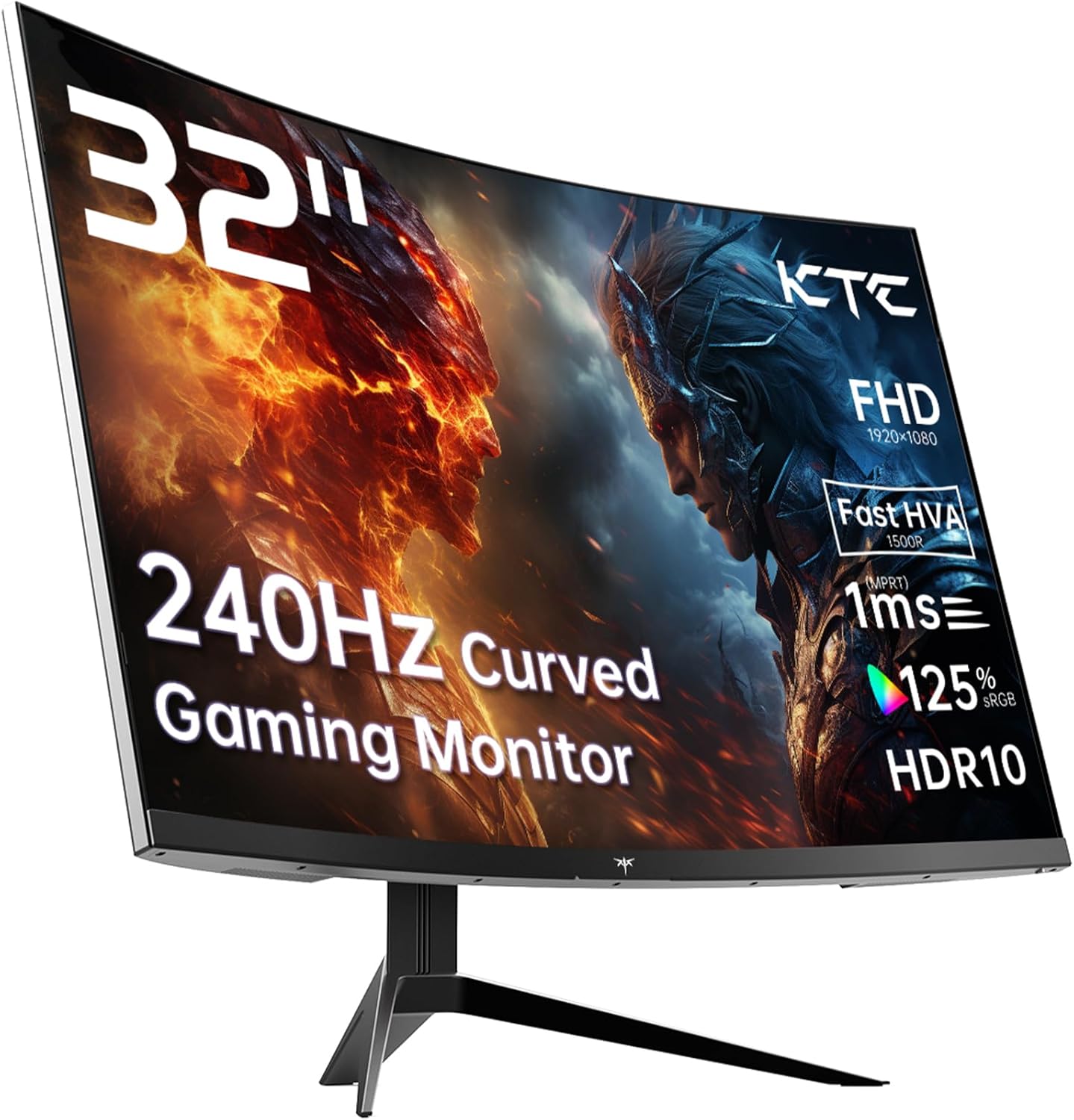
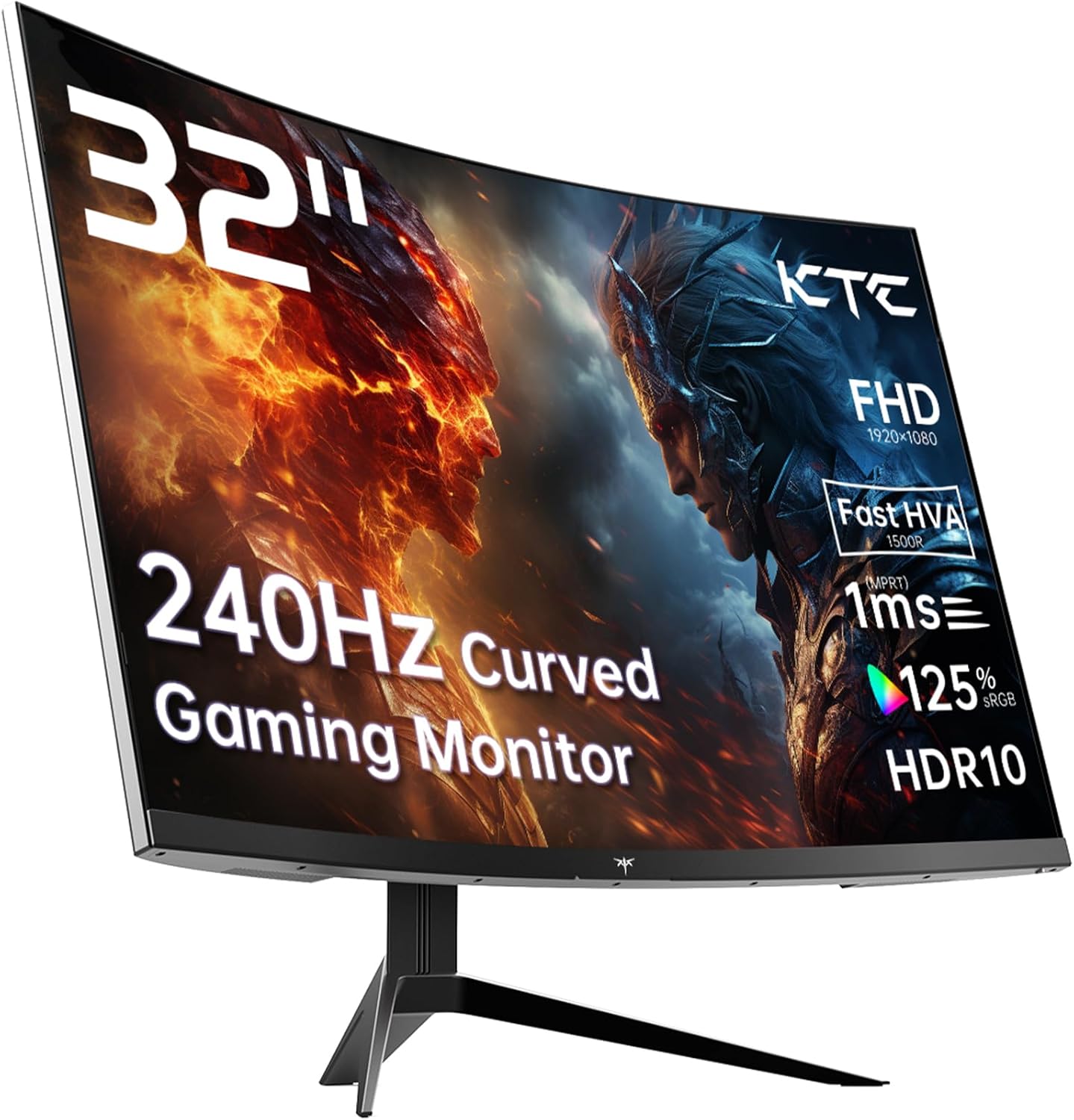
The KTC H32S17F is a 32-inch, 1080p, 240Hz curved gaming monitor built around KTC’s HVA panel technology — and at this price tier, it punches noticeably above its weight on refresh rate and colour output. The headline limitation is equally clear: 1920×1080 on a 32-inch screen is a low pixel density, and anyone who sits close to this thing and cares about sharpness will notice it. That’s not a flaw unique to this monitor — it’s the inherent trade-off of this size and resolution combination, and you need to go in with your eyes open.
What you’re getting in practice: a big, curved, fast screen that handles motion beautifully and produces genuinely vibrant colours. The 240Hz refresh rate and 1ms marketed response time (the spec sheet lists 3ms grey-to-grey — more on that shortly) mean competitive gaming feels genuinely fluid. The 1500R curve wraps the image around your field of view at a 32-inch scale in a way that makes sense. The 3500:1 contrast ratio is strong for an LCD, and HDR10 support at a claimed peak brightness of 350 cd/m² — with at least one buyer reporting peaks closer to 1400 nits — delivers HDR moments that actually land. The 125% sRGB colour gamut gives colours real punch.
This is the right monitor for a console or PC gamer who wants a large, fast screen and isn’t precious about pixel-perfect sharpness. If you sit at a normal desk distance of around 80–90cm, the pixel density becomes much less of an issue. If you’re a creative professional who needs tight resolution, or someone who finds VA viewing angles irritating, look elsewhere. For everyone else — particularly PS5 and Xbox players or anyone upgrading from a TV — this is a compelling option.
See the current listing and availability for the KTC H32S17F on Amazon.

What It’s Best For
Competitive and console gaming is where the KTC H32S17F earns its keep. A 240Hz refresh rate on a budget panel is not something you’d have expected to find a few years ago, and the combination with Adaptive Sync (both FreeSync and G-Sync compatible) means screen tearing is eliminated whether you’re on AMD, NVIDIA, PS5, or Xbox. Fast-paced shooters, racing games, and action titles feel genuinely smooth at this refresh rate — you can feel the difference versus 144Hz in motion-heavy sequences, even if the gap between 165Hz and 240Hz is harder to perceive. The 1500R curve adds real immersion at 32 inches; this isn’t a curve for the sake of a spec sheet entry, it’s a radius that actually wraps the display edge into your peripheral vision.
Home entertainment and casual media use is genuinely well-served here. The 3500:1 contrast ratio gives blacks real depth compared to what a standard IPS delivers, and HDR10 support with strong peak brightness produces highlight moments in films and games that genuinely impress. Buyers have noted brightness so aggressive that sun effects in HDR games caused actual discomfort — that’s not a negative, that’s HDR working as intended. The 125% sRGB gamut coverage keeps colours saturated and vivid without looking unnatural for everyday viewing.
Upgrading from a television is an underrated use case for this specific monitor. At 32 inches with HDMI 2.0 ports, the KTC H32S17F accepts console connections without fuss. The step up from a TV’s typically slow input lag to a monitor’s near-instant response is meaningful for gaming, and the larger screen size makes the transition feel natural rather than like a downgrade. Console players who’ve been gaming on a 32-inch TV will find this a straightforward swap that immediately improves responsiveness.
The Specs That Really Matter
The panel is described by KTC as HVA — their branding for a fast-response VA variant. Traditional VA panels deliver excellent contrast but have historically suffered from slow pixel transitions and noticeable smearing in dark scenes. KTC’s HVA formulation is designed to address that, and the 240Hz refresh rate suggests the pixel response has genuinely been optimised. The VA panel characteristics still apply though: viewing angles are limited compared to IPS. Both buyers and the spec sheet note 178-degree viewing angles, but real-world experience from owners confirms greying out when viewed off-axis. Directly in front of it, colours are excellent. Sit to the side, and you’ll notice. For a desk gaming setup where you’re always centred, this is a non-issue.
The 240Hz refresh rate is the headline spec, and unlike the gap between 144Hz and 165Hz (which is largely marketing), the difference between 144Hz and 240Hz is perceivable in motion-heavy content if your hardware can push the frames. The response time needs a brief clarification: the listing quotes 1ms, but the detailed specification data lists 3ms grey-to-grey. This is a common discrepancy — manufacturers often quote MPRT (motion blur reduction time) as the headline figure while GtG tells the more relevant story. Response time figures measured via MPRT will always look better on paper than GtG. In practice at 240Hz, 3ms GtG is entirely adequate — the refresh cycle itself is 4.2ms, so you’re not being bottlenecked by the panel.
1920×1080 on a 32-inch screen works out to roughly 69 pixels per inch. For context, 1080p on a 24-inch screen is about 92 PPI — noticeably sharper. This matters if you sit close. At around 80–90cm viewing distance the softness becomes much less apparent, and for gaming where you’re focused on movement rather than reading fine text, it’s broadly acceptable. For this size and resolution combination, if text clarity and fine detail matter to you — for office work, reading, or productivity — a 1440p panel at 32 inches would serve you better. If it’s primarily a gaming and media screen, this trade-off is manageable.
Connectivity is straightforward: 2× HDMI 2.0 and 1× DisplayPort 1.4, plus a USB 2.0 port. The HDMI 2.0 ports will cap PS5 and Xbox output at 1080p/120Hz — which is exactly what this panel supports, so no mismatch there. There’s no USB-C, which is worth noting for laptop users hoping to run a single cable setup. The 100×100 VESA mount compatibility is a meaningful inclusion at this price point — more on why that matters shortly.
In 2026, monitors at this refresh rate tier have become more common, but finding 240Hz on a curved 32-inch panel with a 3500:1 contrast ratio and 3-year manufacturer warranty without spending significantly more remains genuinely difficult.
Check the full spec sheet and buyer Q&As for the KTC H32S17F on Amazon.
What Buyers Are Saying
The KTC H32S17F has a small number of UK reviews at the time of writing — fewer than 15 — so treat the sentiment here as directional rather than statistically robust. That said, the feedback is consistent enough to identify clear patterns, and most of it skews positive.
Brightness and HDR performance come up repeatedly as genuine strengths. One buyer described the HDR output as so aggressive that in-game sunlight caused them to instinctively look away — which, for a panel at this price, is striking. Another quoted a peak of 1400 nits, significantly above the specified 350 cd/m²; that figure likely reflects a peak burst brightness rather than sustained output, but either way the HDR delivery clearly lands. Colour quality gets consistent praise — the 125% sRGB coverage translates to visibly punchy, saturated output that several buyers describe as rivalling more expensive displays.
The stand is a recurring grumble. Multiple buyers flagged it as flimsy or basic, and at least one explicitly bought a monitor arm alongside the KTC H32S17F to compensate. The good news: VESA compatibility means that’s a straightforward fix. Viewing angles also get a mention — buyers confirm the VA off-axis limitation is real, and the advice from more than one owner is simply to use this monitor directly in front of you, which for a solo gaming setup is how you’d use it anyway.
The single critical review is worth flagging: one buyer experienced graphical artefacts on the DisplayPort connection after about a month and reported poor after-sales support from KTC — long delays and unanswered emails. One data point isn’t a trend, but KTC is not a brand with the support infrastructure of Dell or LG, and that’s worth factoring in. The 3-year manufacturer warranty is on paper a strong offer; how that plays out in practice if something goes wrong is less certain based on this feedback.
Buyer Highlights
“The picture quality is very nice and it gets laughably bright to the point where if the sun comes out in a game with HDR enabled I have to cover my eyes as if it were the actual sun.” — A vivid sign that the HDR delivery is doing its job at this price point.
“You’d do well to pick up a good monitor arm for this — I’m glad I didn’t end up paying more for a stand I wasn’t going to use anyway.” — The stand weakness is a consistent theme, though VESA support makes it easy to resolve.
“Superbly bright, peaking at 1400 nits, and genuinely giving amazing HDR performance for the money — almost rivalling some OLED displays.” — High praise from a buyer who went in sceptical and came out impressed.
“Viewing angles aren’t amazing, so use this as a monitor directly in front of you — despite that it’s a fantastic screen.” — Practical advice that accurately reflects VA panel behaviour.
“This came up top in all my comparisons for my budget — it delivers the fancy pro-gamer feel without the pro-gamer price tag.” — Sentiment echoed across several buyers who’d done their research before purchasing.
“When it doesn’t work, you do not get any support from KTC.” — An important counterpoint from the one buyer who had a hardware fault and needed after-sales help.

Worth Knowing Before You Buy
The stand situation is worth taking seriously. Multiple buyers independently flagged it as flimsy, and for a 32-inch, 8.2kg panel, a wobbly stand is genuinely annoying. The monitor offers tilt adjustment but no height or pivot adjustment — standard for budget gaming monitors but restrictive if ergonomics matter to you. The 100×100 VESA mount compatibility is the practical fix: a decent monitor arm at this screen size is money well spent, and several buyers already factored this into their setup. If you’re planning to wall mount or arm mount anyway, the stand quality becomes largely irrelevant.
The response time discrepancy is worth understanding before you buy. KTC markets this as a 1ms monitor — the spec sheet says 3ms. As explained in The Specs That Really Matter section, this is a measurement methodology difference rather than deliberate deception, but it’s worth knowing what you’re actually getting. At 240Hz, 3ms GtG is not a problem for gaming; the panel is fast enough for the refresh rate. Just don’t expect TN-panel levels of pixel transition speed.
KTC’s after-sales support appears to be a genuine weak point based on the available feedback. The 3-year warranty is attractive on paper, but the one buyer who needed to use it had a frustrating experience. For a budget monitor from a lesser-known brand, this is somewhat expected — but it means your risk tolerance matters here. If you need rock-solid support coverage, brands like Dell with their advance exchange warranty programmes offer more reliable peace of mind. If you want maximum screen for your money and you’re comfortable accepting that trade-off, the KTC H32S17F remains a strong option. Anyone uncertain about which type of monitor suits their needs and risk appetite should start with our monitor buying guide before committing.
One connectivity note: there is no USB-C on this monitor. Laptop users hoping for a single-cable solution will need to use a separate power connection alongside an HDMI or DisplayPort cable. Not unusual at this price, but worth confirming before purchase if your workflow depends on it.
View current stock levels for the KTC H32S17F on Amazon.
Who Should Buy It (And Who Shouldn’t)
Buy If
- You want a large, fast gaming monitor at a budget price and can accept 1080p resolution at 32 inches — normal desk distances make this manageable for gaming and media use.
- You’re a console gamer on PS5 or Xbox looking to move from a TV to a proper gaming monitor — the dual HDMI 2.0 ports, low input lag, and 240Hz capability make this a direct fit.
- You’re planning to use a monitor arm or wall mount anyway — the VESA compatibility removes the stand as a concern entirely, and you get more screen for less money by not paying for premium ergonomics you weren’t going to use.
- You want genuine HDR impact without spending OLED money — the high contrast ratio and strong peak brightness deliver HDR moments that actually register visually, which HDR400 displays often fail to do.
Avoid If
- You do office work, read a lot of text, or sit close to your screen — 1080p spread across 32 inches produces visible softness that becomes distracting in productivity contexts, and a 1440p panel at the same size would be a much better fit.
- You need reliable manufacturer support or have low tolerance for the risk of a hardware fault going unresolved — KTC’s after-sales track record based on current feedback is not reassuring, and the warranty is only as good as the support behind it.
- You need USB-C connectivity or plan to use a single cable from a laptop — this monitor does not support it, and there’s no workaround short of a dock or adapter.
The Bottom Line
The KTC H32S17F is a genuinely good monitor for what it costs. A 32-inch curved screen at 240Hz with a 3500:1 contrast ratio, strong HDR output, and Adaptive Sync coverage across both major GPU brands is a compelling package — and buyers who’ve purchased it broadly agree. The pixel density trade-off at 1080p is real and you shouldn’t ignore it, but for gaming and entertainment from a normal sitting distance it’s largely a non-issue. The stand needs replacing or bypassing, the support infrastructure is a known question mark, and there’s no USB-C. If none of those things are dealbreakers for your setup, this is a monitor that earns its recommendation without needing much spin.
Find the KTC H32S17F and check current availability on Amazon.
At The Monitor Expert, our approach is built on data transparency rather than simulated hands-on testing. We rigorously analyse official manufacturer specifications and aggregate verified customer sentiment to provide honest, straightforward buying advice that cuts through the marketing noise.
As an Amazon Associate, I earn from qualifying purchases.
Browse by Specification
Looking for something specific? Browse our analyses by hardware and feature below, or check all monitor analyses in the Gaming Monitors and Budget Monitors category archives.
[IPS Monitors] — [VA Monitors] — [TN Monitors] — [OLED Monitors]
Browse by Refresh Rate
[60Hz] — [75Hz] — [100Hz] — [120Hz] — [144Hz] — [165Hz] — [180Hz] — [200Hz] — [240Hz+] — [360Hz+]
Browse by Screen Size
[Small Screen] — [24-inch] — [27-inch] — [32-inch] — [Large Screen] — [Ultrawide]