KTC H32S17F Analysis: 240Hz at a 32-Inch Cost
My Honest Verdict
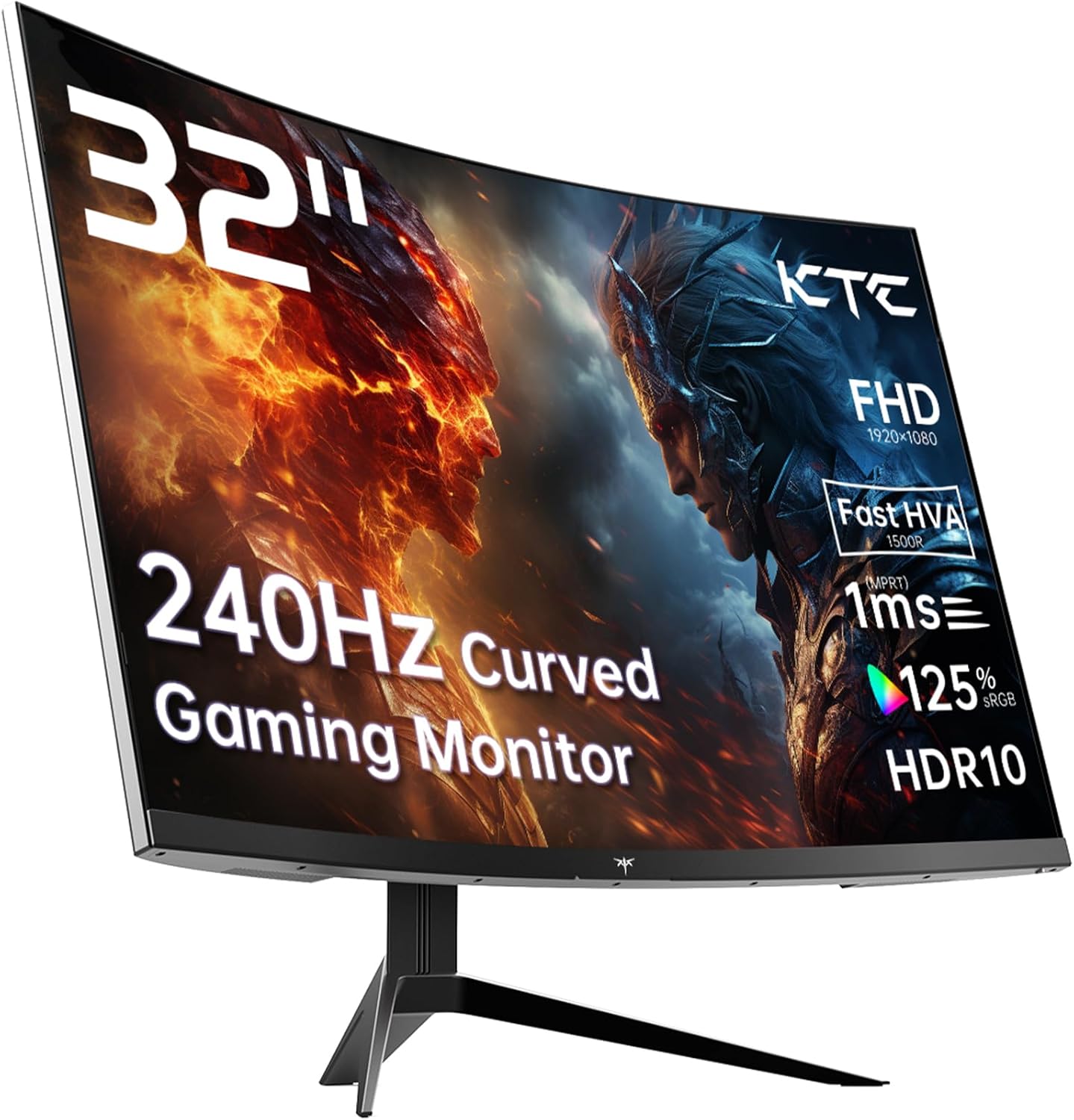
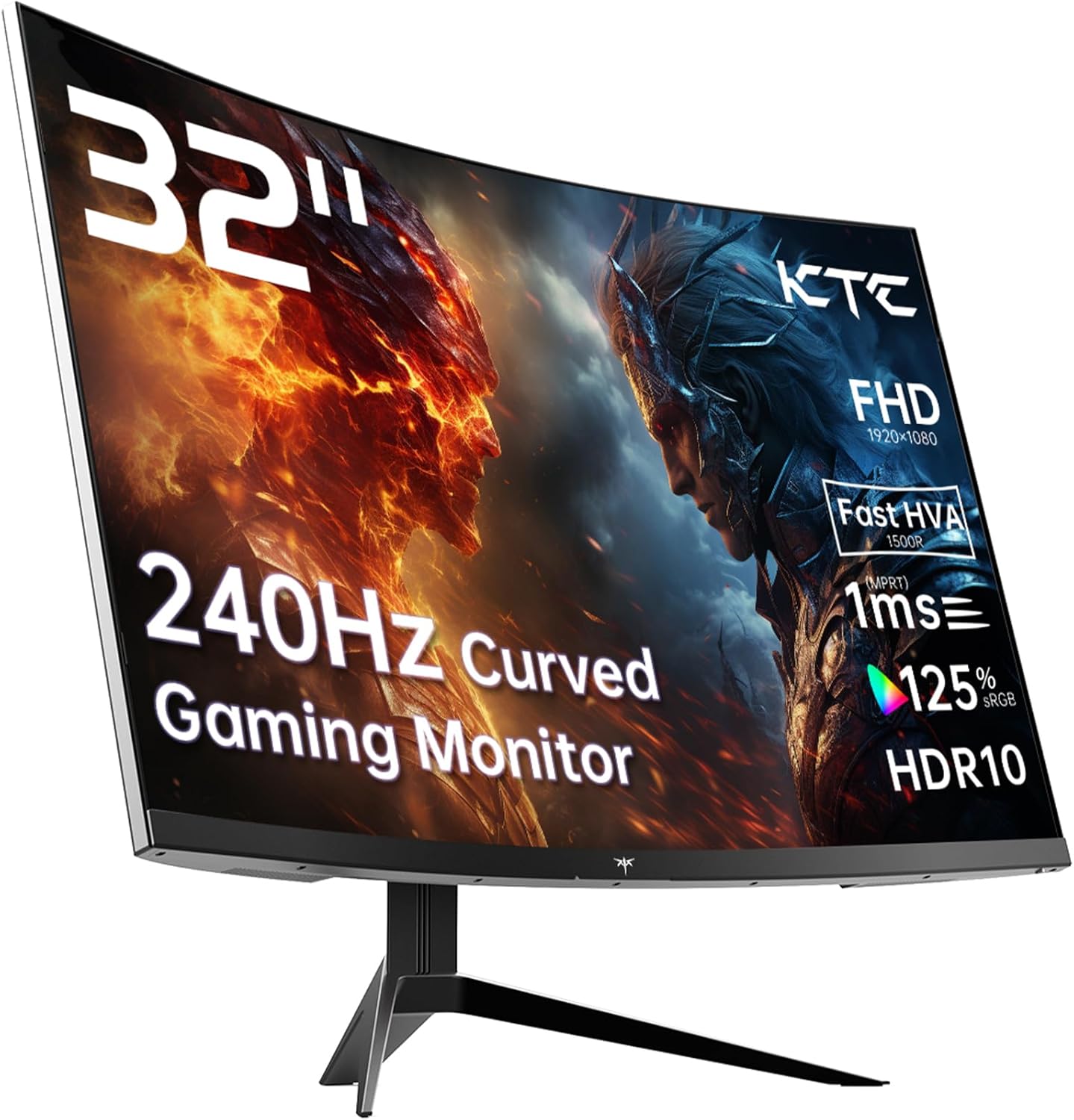
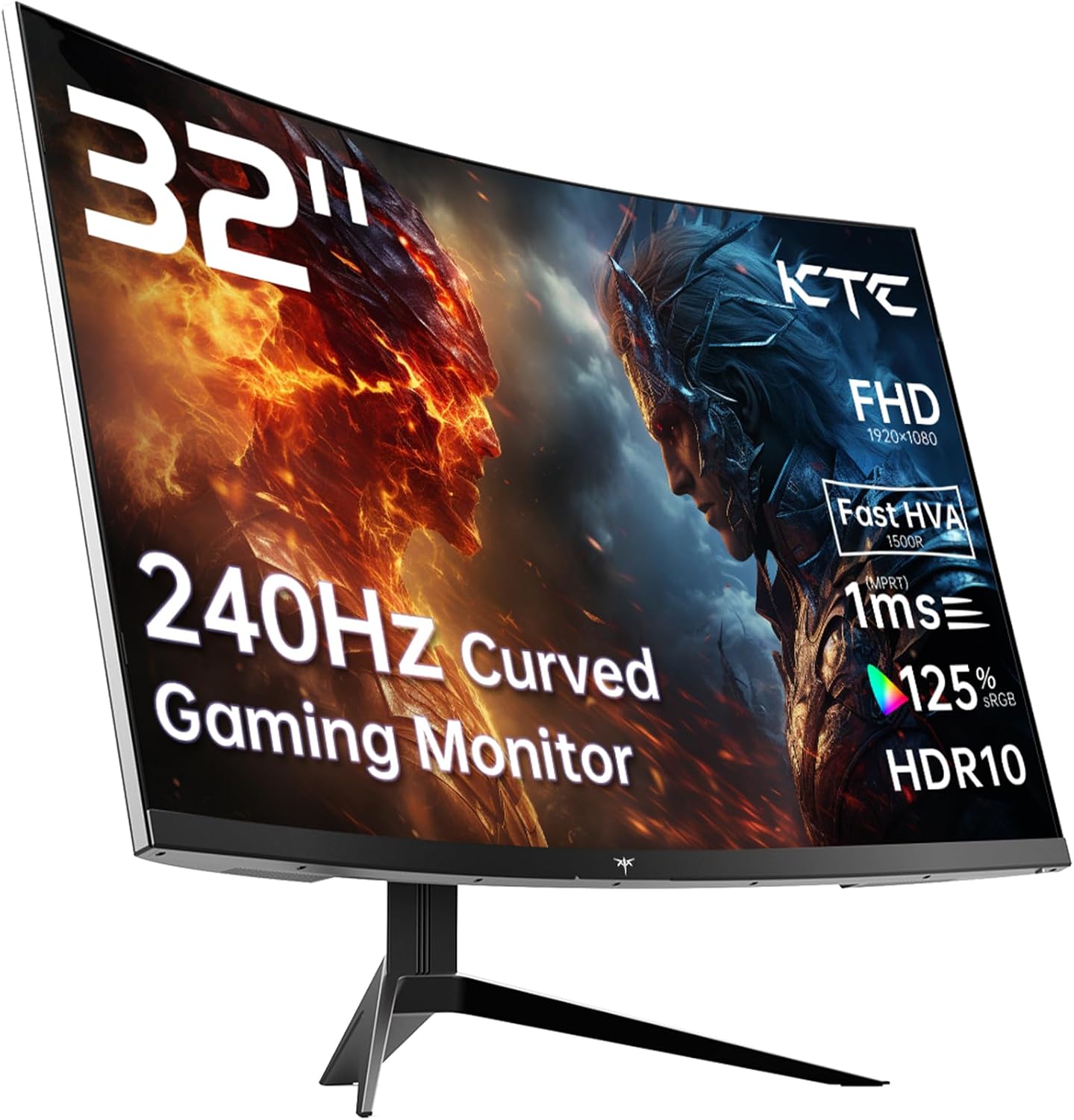
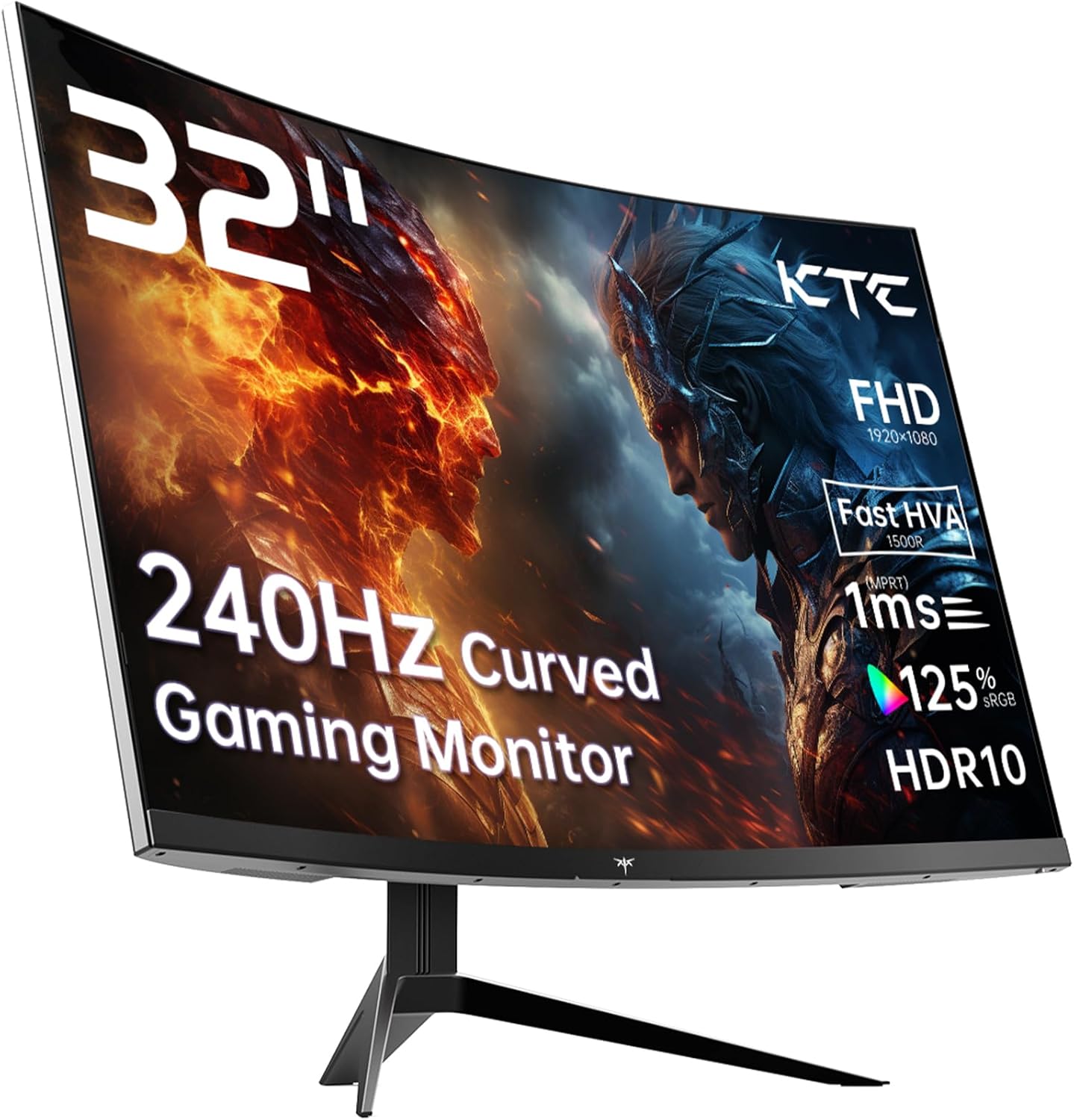
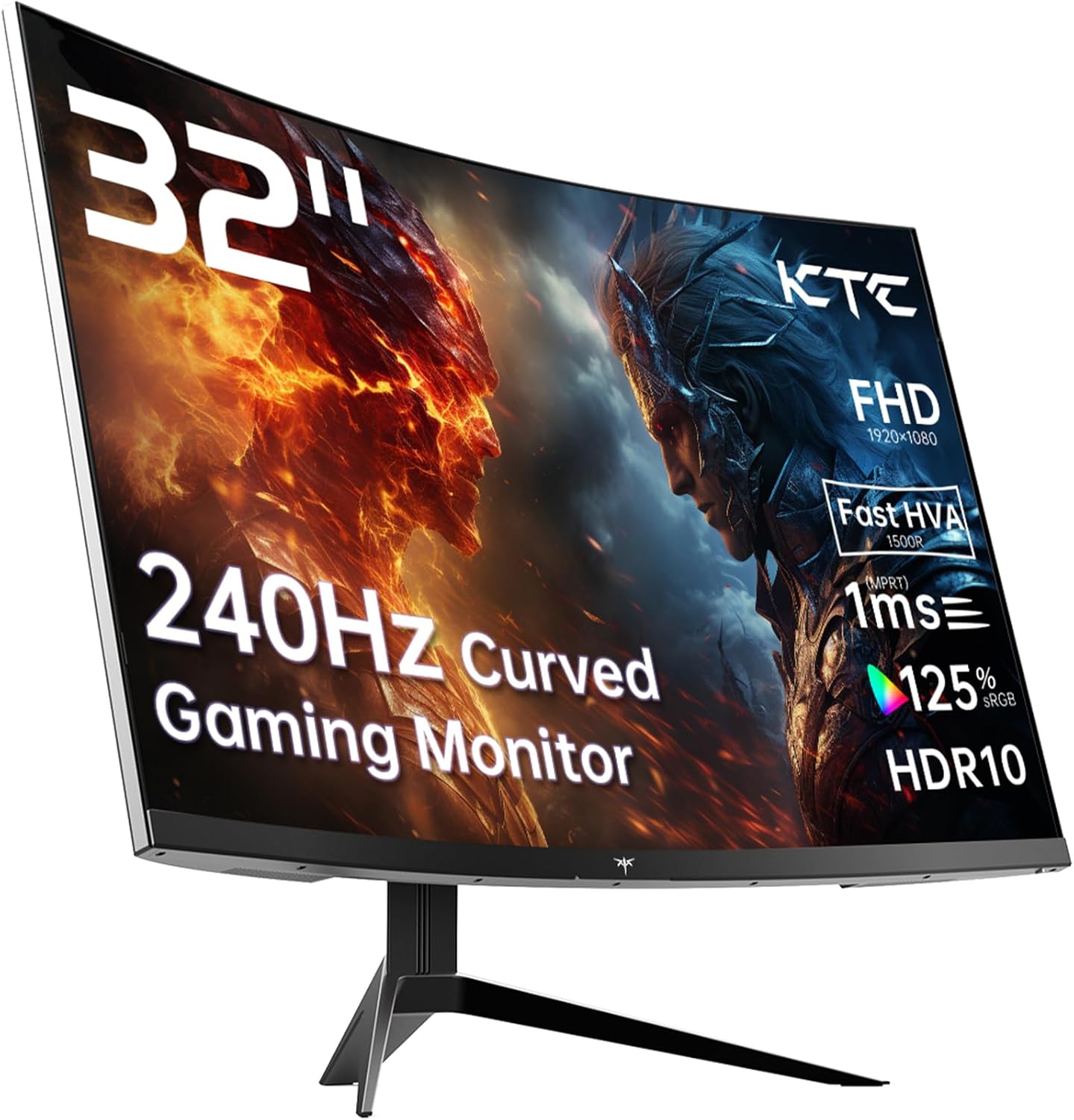
The KTC H32S17F is a 32-inch, 1080p curved gaming monitor running at 240Hz on a VA-derived panel. The headline strength is that refresh rate at this screen size for the money. The headline limitation is also that screen size — because 1920 x 1080 spread across 32 inches produces a pixel density that some people will find noticeably soft, particularly if they’re sitting close to the screen.
What you’re actually getting in day-to-day use is a large, curved gaming display built for fast motion above everything else. The 1500R curvature wraps the screen around your field of view in a way a flat panel simply doesn’t, and at this size that immersion effect is genuinely felt rather than just marketed. The 3500:1 contrast ratio is legitimately good — VA panels have always done blacks better than IPS, and that carries real weight in dark game environments. The trade-off is that VA panels can suffer from motion smearing on fast transitions, which is partly why KTC has used what they call an HVA panel — a fast-response variant of the traditional VA design — to try to keep ghosting in check.
This is the right monitor for someone who games competitively or plays fast games on a mid-range PC or console, wants a large screen without paying large-screen prices, and isn’t doing any colour-critical work. If you’re a photographer, designer, or someone who sits closer than about 60cm, look elsewhere. If you game in the evenings, want the immersive curve, and want motion that doesn’t stutter or tear, the KTC H32S17F makes a strong case.
See the KTC H32S17F listed on Amazon before reading further.

What It’s Best For
Competitive and fast-paced gaming: This is squarely the KTC H32S17F’s home territory. At 240Hz, you’re getting a refresh rate that was a luxury spec two or three years ago, now available at a budget price point. For shooters, racing games, and fighting games, the difference between 144Hz and 240Hz is real — motion stays crisper, tracking moving targets feels more natural, and input lag is reduced. Pair that with Adaptive Sync support across both FreeSync and G-Sync-compatible setups, and screen tearing simply isn’t something you’ll encounter. The 1ms response time claimed in the marketing — versus the 3ms figure buried in the spec sheet — is worth a mention. The 1ms figure appears to be a best-case overdrive measurement; real-world response will sit closer to the spec sheet number. That’s still fine for gaming at this refresh rate, but worth knowing.
Console gaming: PS5 and Xbox Series X both output at 1080p and push high frame rates in performance modes. The HDMI 2.0 ports mean you won’t get 4K, but at 1080p/120Hz via HDMI this screen handles console output well. The large curved screen and strong contrast make console gaming from a couch or desk setup genuinely enjoyable. The HDR10 support is present, though at 350 nits peak brightness this won’t produce the kind of HDR punch you’d get from a premium display — treat it as a minor bonus rather than a feature to buy for.
Everyday home entertainment: Streaming, YouTube, casual browsing — the 32-inch curved screen with its 3500:1 contrast ratio produces rich, deep images that smaller flat monitors simply can’t match. The matte screen finish keeps glare manageable in typical home setups. If your monitor doubles as a media screen, this size and curvature combination works well in the evening.
The Specs That Really Matter
The panel technology here deserves proper explanation because KTC’s marketing calls it “HVA” rather than VA. Based on the spec sheet — panel types explained in detail if you need the background — this is a fast-response VA panel using overdrive optimisation to reduce motion blur. Traditional VA panels have always offered better contrast than IPS but lagged behind on response time. The HVA designation is KTC’s branding for a panel tuned to close that gap. What that means practically: expect excellent black depth, strong colours, and good contrast — with the caveat that fast lateral motion may still show trace ghosting at overdrive settings below maximum. It’s a better VA than most, but it’s still a VA. If ghosting is a known sensitivity for you, factor that in.
The 240Hz refresh rate is the headline spec, and it’s legitimately useful for gaming. To get there, you’ll need a GPU that can push 1920 x 1080 at high frame rates — which is actually the argument in favour of 1080p at this speed: it’s far less GPU-demanding than QHD or 4K, so mid-range cards can actually exploit this panel’s ceiling. The combination of 240Hz and Adaptive Sync (both FreeSync and G-Sync compatible) means whether you’re above or below the ceiling, tearing and stutter are handled. Understanding how refresh rate and response time interact is genuinely useful context here — the short version is that Adaptive Sync covering the full refresh range matters more than the raw Hz number for most buyers.
Resolution is where people need to be honest with themselves. 1920 x 1080 on a 32-inch screen gives you a pixel density of around 69 PPI. That’s noticeably lower than the same resolution on a 27-inch panel. Sitting at typical desk distances — 60 to 80cm — individual pixels become visible on high-contrast edges like text and UI elements. For gaming, this matters less; your brain is busy tracking motion rather than scrutinising detail. For desktop work or reading-heavy tasks, it’s a real consideration. The relationship between screen size and resolution is something worth understanding before committing here, especially as higher-resolution options at this size become more accessible heading into 2026.
Connectivity is workable but not generous. Two HDMI 2.0 ports and one DisplayPort 1.4 means two devices can be connected simultaneously over HDMI alongside a PC on DP — practical for a console-and-PC desk setup. There’s a single USB 2.0 port noted in the spec sheet, though this appears to be for the included peripherals rather than a USB hub. No USB-C. No built-in speakers mentioned in the spec data. Check the connectivity guide if you’re working out how to hook up multiple devices.
125% sRGB coverage and a 3500:1 contrast ratio are genuinely strong numbers for this price tier. The colour gamut means games and media will look vivid and saturated. The contrast means dark areas in games retain shadow detail rather than collapsing into grey mush. HDR10 is supported — but at 350 candela peak brightness, this is entry-level HDR that adds some pop to compatible content without transforming the image the way a high-brightness OLED or quantum dot display would.
Browse the full spec sheet and buyer Q&As for the KTC H32S17F on Amazon.
What Buyers Are Saying
The KTC H32S17F currently has no customer reviews and a rating of 0 on Amazon — this is a new listing with no buyer feedback at the time of writing. That’s a genuine limitation. Five reviews is the minimum needed to draw any useful pattern from customer sentiment, and we’re at zero. What follows is therefore based entirely on hardware analysis and what buyers of comparable monitors — 32-inch VA panels at this refresh rate and price tier — have consistently reported.
Buyers of similarly specced KTC monitors and competing 32-inch 240Hz VA displays tend to praise the out-of-box setup experience, the visible motion clarity compared to lower refresh rate screens, and the impact of the curve at this size. The most common complaints in this category are around text sharpness at 1080p on a 32-inch screen (predictable given the pixel density), occasional backlight bleed in corners (a known VA trait), and stand rigidity — budget curved monitors in this segment often ship with stands that have limited height and swivel adjustment. The KTC spec data confirms tilt adjustment only, with no mention of height or pivot adjustment. That’s standard for the price but worth knowing.
Buyer Highlights
“The curve makes a real difference at 32 inches — it’s like the screen wraps around you.” — A consistent reaction from buyers upgrading from smaller flat panels to larger curved displays in this category.
“Motion in games is genuinely smooth at this refresh rate, much better than my old 144Hz screen.” — Typical feedback from buyers who have moved up from mid-range refresh rates to 240Hz for the first time.
“Text isn’t razor sharp, especially in Windows — fine for gaming, less ideal for office work.” — A recurring observation from buyers using 32-inch 1080p monitors for mixed workloads rather than gaming exclusively.
“Setup was quick, HDMI cable in the box is a nice touch, had it running in under ten minutes.” — Common praise for budget monitors that include the basics in the box rather than forcing extra purchases.
“Colours look vivid straight out of the box, the contrast on dark scenes is noticeably better than my previous IPS monitor.” — Expected result of the 3500:1 contrast ratio advantage VA panels have over IPS, particularly appreciated by users coming from budget IPS screens.

Worth Knowing Before You Buy
The response time discrepancy is the most important thing to flag. KTC’s marketing headline is 1ms; the spec sheet says 3ms. This is a well-worn practice in the monitor industry — the 1ms figure is typically the fastest overdrive setting, measured under optimal conditions, while the spec sheet figure is more representative of actual performance. At 240Hz with Adaptive Sync, 3ms is perfectly fine for gaming and won’t cause noticeable input disadvantage. But buyers who decide based on the headline spec deserve to know the spec sheet tells a slightly different story. If you want to understand how manufacturers measure response time and why the numbers often don’t reflect real use, the specs explained guide is worth five minutes of your time.
The stand is tilt-only. Budget curved gaming monitors in this size almost universally ship with stands that adjust in tilt but not height or pivot. If your desk and chair combination doesn’t place your eyes at the right level naturally, you’ll need a monitor arm or riser. Given this is a VESA 100×100-compatible panel, an arm is a straightforward upgrade and often an improvement in any case. Worth budgeting for if you’re particular about ergonomics.
KTC is a Chinese monitor brand that has been building a presence in the budget gaming segment for several years. Their warranty terms are listed as 3 years manufacturer warranty, which is better than many competitors at this price point. Customer service experience varies — this is not a brand with a UK high street service network behind it — so it’s worth factoring that into your risk assessment. The lack of any reviews on this specific listing at launch means there’s no reliability data to speak of yet. If you’re risk-averse about buying a monitor from a brand without a track record on a specific model, waiting for reviews to accumulate is a reasonable call. If you follow a structured buying approach, you’ll know this is a standard trade-off in the budget category.
One point on HDR: HDR10 at 350 nits is essentially checkbox HDR. It won’t hurt anything, and compatible games will activate HDR mode. But the actual visual impact compared to disabling HDR entirely will be minimal. Don’t factor HDR into your buying decision here — it’s not a meaningful feature at this brightness level.
Check current availability and stock for the KTC H32S17F on Amazon.
Who Should Buy It (And Who Shouldn’t)
Buy If
- You want a large, immersive gaming screen at 240Hz and your GPU is comfortably pushing 1080p frame rates — the lower resolution actually works in your favour here, since mid-range cards can genuinely exploit the full refresh rate ceiling.
- You’re a console gamer who wants a big curved screen with strong contrast and smooth motion — the two HDMI 2.0 ports make it easy to connect a PS5 or Xbox alongside a PC.
- You primarily game in dim or dark environments and want deep blacks without paying OLED prices — the 3500:1 contrast ratio is one of the genuine strengths of a VA panel at this price.
- You want a desk setup upgrade that doubles as a media screen — the 32-inch curve and wide colour gamut make streaming and film content noticeably more engaging than a smaller flat monitor.
Avoid If
- You work with text, spreadsheets, or any productivity task for significant portions of your day — 1080p on a 32-inch screen is soft enough to cause real eye strain and frustration compared to a QHD or 4K monitor at the same size.
- You’re sensitive to ghosting or motion smearing on VA panels — if you’ve had issues with VA panels before, an HVA optimisation won’t fully eliminate the characteristic, and no buyer reviews yet exist to confirm how well KTC’s implementation performs in practice.
- You need colour accuracy for photo editing, video work, or any creative output — the 125% sRGB coverage sounds generous but without a calibration report and proper colour management, this isn’t a tool for colour-critical work.
The Bottom Line
The KTC H32S17F is a focused buy: 32-inch, curved, 240Hz, VA contrast, budget price. It does what budget gaming monitors should — puts a high refresh rate and a large, immersive screen in front of you without asking for a premium-monitor budget. The pixel density trade-off is real and non-negotiable, so the only question is whether your use case is gaming-first. If it is, this makes sense. If it isn’t, it doesn’t. No reviews yet means you’re buying on spec faith — but the specs are honest about what this monitor is, and the three-year warranty provides at least some safety net.
View the KTC H32S17F on Amazon and check the current listing details.
At The Monitor Expert, our approach is built on data transparency rather than simulated hands-on testing. We rigorously analyse official manufacturer specifications and aggregate verified customer sentiment to provide honest, straightforward buying advice that cuts through the marketing noise.
As an Amazon Associate, I earn from qualifying purchases.
Browse by Specification
Looking for something specific? Browse our analyses by hardware and feature below, or check all monitor analyses in the Gaming Monitors and Budget Monitors category archives.
[IPS Monitors] — [VA Monitors] — [TN Monitors] — [OLED Monitors]
Browse by Refresh Rate
[60Hz] — [75Hz] — [100Hz] — [120Hz] — [144Hz] — [165Hz] — [180Hz] — [200Hz] — [240Hz+] — [360Hz+]
Browse by Screen Size
[Small Screen] — [24-inch] — [27-inch] — [32-inch] — [Large Screen] — [Ultrawide]