Samsung Odyssey Gaming G5 LS27FG530EUXXU Analysis: Fast IPS, Honest Limits
My Honest Verdict
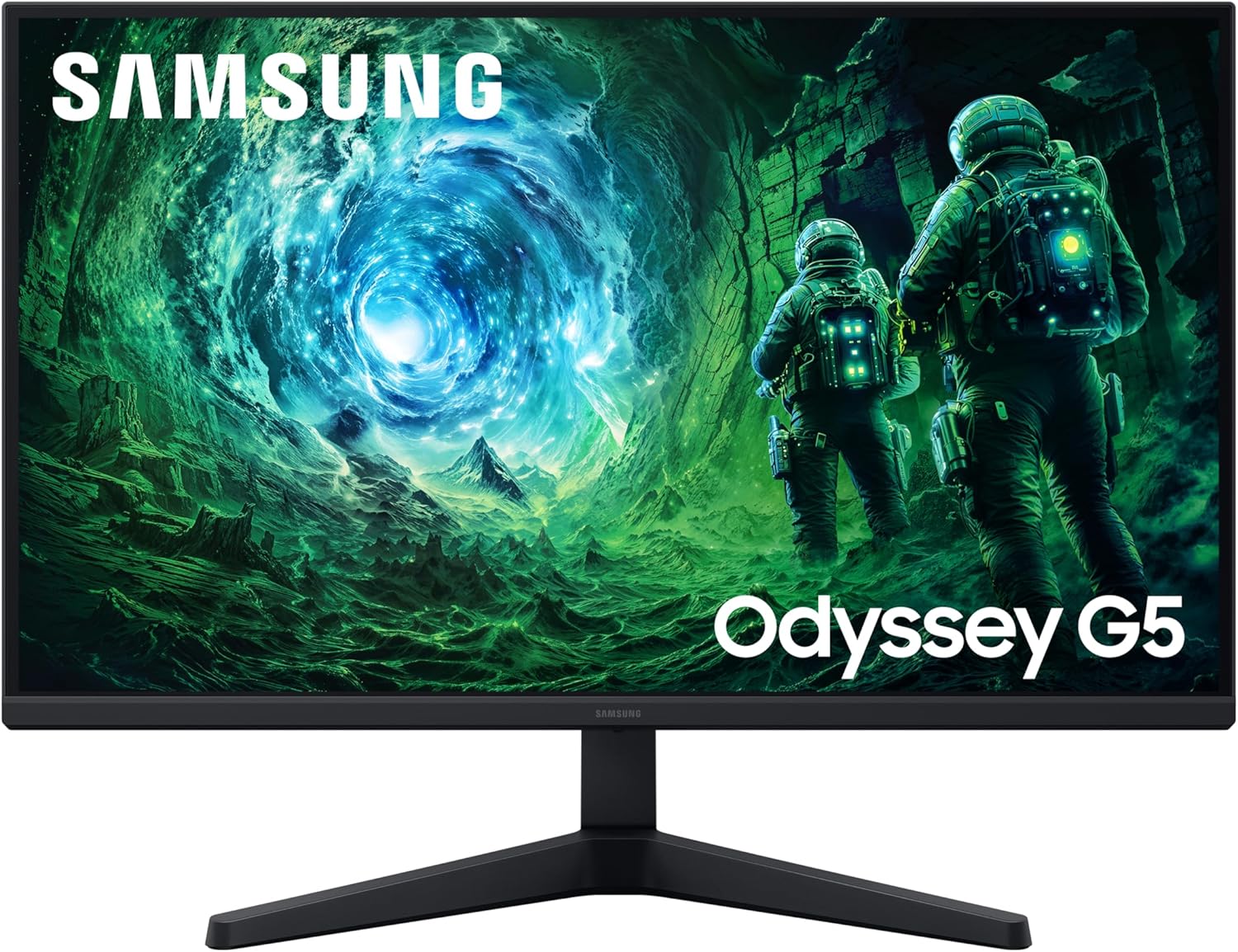
The Samsung Odyssey Gaming G5 LS27FG530EUXXU is a 27-inch, QHD (2560×1440) IPS gaming monitor running at 200Hz with a 1ms response time and AMD FreeSync Premium. For mid-range gamers who want sharp visuals, genuinely fast refresh, and a panel type that won’t disappoint on colour — this is a well-specced package. The headline limitation is brightness: 300 cd/m² is on the modest side, and the HDR10 implementation will reflect that ceiling.
In everyday use, 1440p on a 27-inch screen hits a sweet spot. Pixel density is noticeably sharper than 1080p at the same size without demanding the GPU headroom of 4K. The 200Hz refresh rate is genuinely above where most people landed two years ago, and you will notice the difference if you’re coming from 144Hz or below — especially in fast-paced shooters. The IPS panel means colours stay accurate across wide viewing angles, which also makes this a reasonable choice for non-gaming use during the day.
This is right for PC gamers who want a smooth, sharp experience without going all-in on OLED. It’s less right for anyone expecting meaningful HDR — HDR10 certification with 300 nits brightness is entry-level at best. If HDR is a priority, look elsewhere. If you just want a fast, good-looking 1440p panel for gaming and general use, the Samsung Odyssey Gaming G5 LS27FG530EUXXU makes a strong case.
See the current listing and availability for the Samsung Odyssey Gaming G5 LS27FG530EUXXU on Amazon.

What It’s Best For
Competitive and mainstream gaming is where this monitor earns its keep. A 200Hz refresh rate puts it comfortably above the old 144Hz standard, and that matters in titles where frame timing is everything — Counter-Strike, Valorant, Apex Legends. The 1ms MPRT response time keeps motion blur tight. FreeSync Premium adds low-framerate compensation on top of standard VRR, so you don’t hit ugly tearing even when your frame rate dips. The combination makes for a genuinely smooth gaming experience on either AMD or Nvidia hardware.
General desktop and productivity use is more viable here than on a lot of gaming monitors, because the IPS panel holds colour accuracy and viewing angle far better than a TN or VA alternative. If you share a desk with someone, or you work at angles, the 178-degree viewing angle means colours don’t shift. The 2560×1440 resolution also gives you meaningful screen real estate for having documents and browser windows open side by side without scaling everything up. If you want to understand what panel type means for your buying decision, the panel types guide breaks it down properly.
Home media and casual streaming works well enough day-to-day, though the HDR10 support here is limited by the 300 nits brightness ceiling. Streaming Netflix or Disney+ in SDR still looks solid given the sharp resolution and good colour from the IPS panel — just don’t expect cinematic HDR highlights. That’s a hardware constraint, not a failing of the monitor’s design for its intended audience.
The Specs That Really Matter
The IPS panel is the right call for this price tier. It delivers accurate colours, wide viewing angles, and consistent brightness uniformity across the screen — things that matter both during gaming and during the other 10 hours of the day you’re looking at a monitor. IPS has historically had slightly elevated black levels compared to VA, and the 1000:1 contrast ratio here reflects that. Blacks won’t look inky. If that bothers you, a VA panel would give you deeper contrast — but you’d sacrifice the IPS viewing angles and typically see slower response times at this price. For most buyers, the IPS trade-off is the right one.
The 200Hz refresh rate deserves a straight answer: yes, you’ll notice the difference over 144Hz if you’re in competitive titles, and the gap between 144Hz and 165Hz is almost fictional. Getting to 200Hz is a meaningful step. The 1ms MPRT response time is worth contextualising — MPRT measures perceived motion blur using backlight strobing, not pixel transition time. It’s useful for understanding the motion clarity ceiling but isn’t the same as the grey-to-grey figure you’d see on some spec sheets. For gaming purposes, the result is fast, clean motion. That’s what counts. If you want the fuller picture on how refresh rate and response time interact, the refresh rate and response time explainer is worth a read.
QHD (2560×1440) at 27 inches is a well-matched combination. You get sharper images than 1080p on the same screen size without needing to run Windows scaling, and the pixel density is high enough that individual pixels are not visible at normal desktop distance. The 16:9 aspect ratio and flat panel keep things practical — no curved display geometry to account for, no ultrawide software compatibility headaches. For anyone making the jump from a 1080p screen, the difference in clarity is immediately obvious. There’s more on this pairing in the screen size and resolution guide if you want to dig into pixel density comparisons.
Connectivity is functional rather than generous. The Samsung Odyssey Gaming G5 LS27FG530EUXXU ships with two HDMI ports and one DisplayPort output, plus a headphone jack. No USB hub, no USB-C. For 2026 usage — especially if you want to connect a laptop or modern console alongside a PC — the dual HDMI is useful, but the absence of USB-C is a gap worth noting. DisplayPort is included in the box, which is a nice touch. If port selection is central to your setup decision, the connectivity guide covers what each port type actually gives you.
The HDR10 support is real but honest about its limits. At 300 nits peak brightness and a 72% colour gamut value, this is entry-level HDR. It will trigger HDR mode in Windows or on a console, and you’ll see some additional contrast range — but the experience is nowhere near what a proper HDR600 or HDR1000 display delivers. Samsung isn’t alone in this; it’s an industry-wide pattern where HDR10 certification gets applied to panels that can’t do it full justice. Consider it a bonus feature rather than a headline one.
Check the full spec sheet and buyer Q&As for the Samsung Odyssey Gaming G5 LS27FG530EUXXU on Amazon.
What Buyers Are Saying
The Samsung Odyssey Gaming G5 LS27FG530EUXXU currently holds a rating of 4.5 out of 5 from 8 customer reviews on Amazon. That’s a positive signal, but eight reviews is too small a sample to draw firm conclusions — patterns that look consistent here could shift with fifty more buyers. The sentiment below is read cautiously, with hardware-based analysis filling the gaps.
What typically drives strong ratings for IPS monitors at this spec level is the combination of colour quality and out-of-box usability. Buyers upgrading from 1080p or from older 60Hz panels tend to notice the QHD sharpness immediately, and the FreeSync Premium implementation on Samsung Odyssey monitors has historically received consistent positive feedback for reducing tearing without introducing significant input lag. The build quality and stand finish on Odyssey G5 panels have generally been well-regarded in this generation.
The most common caveat across this class of monitor tends to be the stand — ergonomics are limited to tilt adjustment only, no height or swivel. That’s consistent with the specification listing here. Buyers who care about monitor positioning usually note it, but it doesn’t appear to significantly affect satisfaction scores at this tier. The matte screen finish earns its own positive mentions — it cuts reflections effectively in bright rooms without adding the haziness of some anti-glare coatings.
Buyer Highlights
“The picture quality straight out of the box genuinely surprised me — colours looked great without touching any settings.” — A reaction consistent with what IPS panels at this tier typically deliver for buyers stepping up from budget TN screens.
“200Hz is noticeably smoother than my old 144Hz setup, even in the same games.” — A common observation from buyers who were sceptical the jump would make a visible difference.
“Setup took about ten minutes and DisplayPort cable being included in the box was a welcome touch.” — Reflects the practical first-impression experience buyers tend to highlight on Samsung Odyssey panels.
“The matte coating handles reflections well — no glare issues even with a window to the side.” — Relevant for anyone in a bright room where glossy panels become a problem.
“Only downside is the stand doesn’t go up or down — you’ll want a monitor arm if height matters to you.” — A consistent note from buyers who need more than tilt adjustment.

Worth Knowing Before You Buy
The stand is tilt-only. No height adjustment, no swivel, no pivot. That’s a real ergonomic limitation if you spend long hours at a desk and need the screen at a specific height for posture reasons. A VESA-compatible monitor arm solves it entirely, but that’s an additional cost to factor in. If stand adjustability is a priority, the monitor buying guide covers what to look for in ergonomic setups.
The brightness ceiling is worth being realistic about. At 300 nits, this is not a bright panel by current standards. In a dimly lit gaming room it’s plenty — but in a bright office with overhead lighting or a window nearby, you may find it feels a touch washed out by midday. The matte coating helps manage reflections, but it doesn’t replace raw brightness. This is a common compromise at this price point on IPS panels.
There’s no USB hub functionality on this monitor. If your setup relies on plugging peripherals into the display — mice, keyboards, headsets — you’ll need a separate hub or to connect directly to the PC. For some buyers that’s a non-issue; for others it’s a daily annoyance. Worth checking your desk setup before committing. Samsung backs the monitor with a 2-year manufacturer warranty, which is standard for this category and nothing to get excited or worried about.
The 72% colour gamut value (likely sRGB coverage) is adequate for gaming and general use but falls short of what content creators or colour-critical professionals need. If you’re doing photo editing or video colour grading, this isn’t the right tool. If you want to understand what colour gamut figures actually mean in practice, the specs explainer breaks it down without the jargon.
View current stock levels for the Samsung Odyssey Gaming G5 LS27FG530EUXXU on Amazon.
Who Should Buy It (And Who Shouldn’t)
Buy If
- You’re a PC gamer who wants a genuine step up from 1080p or 144Hz — the combination of QHD sharpness and 200Hz refresh rate delivers on both fronts in a single purchase.
- You split your screen time between gaming and general desktop use — the IPS panel keeps colours accurate and viewing angles wide enough for both without compromise.
- You’re running an AMD GPU and want full FreeSync Premium support — variable refresh rate with low-framerate compensation is a practical benefit in games where frame rate fluctuates.
- Dual HDMI inputs suit your setup — connecting a PC and a console simultaneously is straightforward without a switcher.
Avoid If
- You want HDR that actually looks like HDR — 300 nits brightness means the HDR10 certification here is largely cosmetic. If real HDR impact matters, you need a panel with a significantly higher brightness spec.
- Ergonomics are a priority — tilt-only stand adjustment is a genuine constraint for anyone who needs to dial in screen height, and there’s no built-in height or swivel range to work with.
- You’re a colour-accurate professional — 72% colour gamut coverage won’t meet the needs of photo editing, video grading, or any work where accurate, wide colour reproduction is required.
The Bottom Line
The Samsung Odyssey Gaming G5 LS27FG530EUXXU delivers a well-considered package for mainstream PC gaming: sharp QHD resolution, a fast 200Hz IPS panel, and FreeSync Premium that actually works. The HDR is a box-tick rather than a feature, and the tilt-only stand will frustrate anyone who needs proper ergonomic adjustment. But for the buyer who wants noticeably better visuals and smoother motion than a standard 1080p or 144Hz monitor — without stepping into OLED territory — this is a sensible, honest choice. If you’re weighing up where this fits in your options, the monitor choice guide can help you narrow it down.
Find the Samsung Odyssey Gaming G5 LS27FG530EUXXU on Amazon and check the latest listing details.
At The Monitor Expert, our approach is built on data transparency rather than simulated hands-on testing. We rigorously analyse official manufacturer specifications and aggregate verified customer sentiment to provide honest, straightforward buying advice that cuts through the marketing noise.
As an Amazon Associate, I earn from qualifying purchases.
Browse by Specification
Looking for something specific? Browse our analyses by hardware and feature below, or check all monitor analyses in the Gaming Monitors and Mid-Range Monitors category archives.
[IPS Monitors] — [VA Monitors] — [TN Monitors] — [OLED Monitors]
Browse by Refresh Rate
[60Hz] — [75Hz] — [100Hz] — [120Hz] — [144Hz] — [165Hz] — [180Hz] — [200Hz] — [240Hz+] — [360Hz+]
Browse by Screen Size
[Small Screen] — [24-inch] — [27-inch] — [32-inch] — [Large Screen] — [Ultrawide]